The Whistlesmith Package
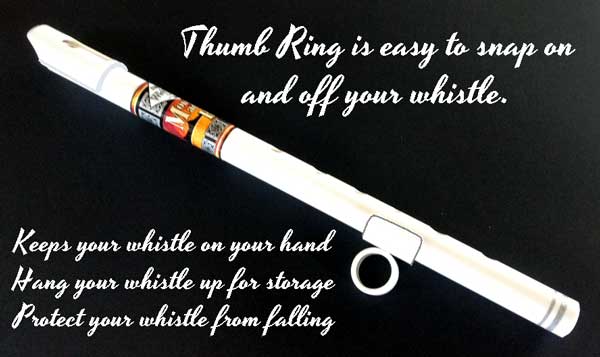
Sometimes you think of everything and leave out something really important! Here is a photo my wife, Nadiene took and brought to my attention. I had not published a picture of the total package you receive when you purchase your new whistle. The fingering chart is printed on heavy paper and is nice and big (11 x 17 inches) so it is easy to see when you practice. All the fingering charts are color coded for each whistle key to make the notes and the fingering easy to understand. The tech sheet shows how your whistle goes together and has tips on maintaining and cleaning the instrument. Of course there is a thumbring included with your whistle and everything is packed in a very sturdy triangular box with bubble wrap.
Posted by The WhistleSmith at
7:53 PM
|
TrackBack
Nice tip for Big Thumbs
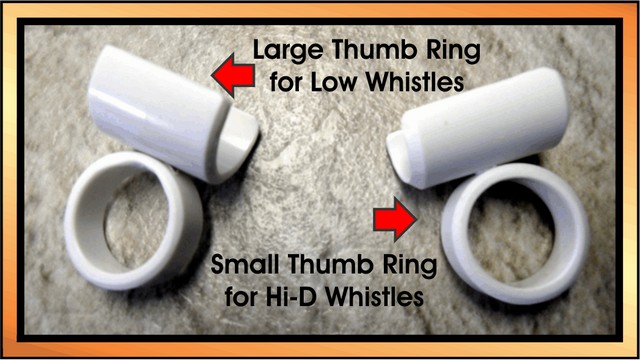
Gary Robinson wrote a nice email with a fix for folks with big fingers. He cut the bottom out of his thumbring just below the halfway mark, filed it nice and smooth and found the open bottom ring was just fine and still gave a nice hold on his thumb. The original person that tested the thumbring wore a size 12 ring and had big hands, so I figured that would be sufficient. Nice solution, Gary
!
Posted by The WhistleSmith at
7:25 PM
|
TrackBack
Mouthpiece for Low D Flute
The New Side Shooter Mouthpiece converts the Low D Whistle to an automatic flute. Fingering for the Low D Flute is exactly the same as the whistle making this a really neat dual purpose instrument. Mouthpiece slides apart to be easily cleaned, has hollow head with clear acrylic plugs, and the tuning slide is built in just like the Low D whistle head. No learning curve to play this flute if you already know whistle fingering for Hi or Low D whistle. Price is $25. Available
for immediate shipment. Flute head fits only Whistlesmith Low D whistles.
Low D Flute Head
Priced at $25.00
Shipping Calculated at checkout
Please Add it to Your Cart
Note: International orders will be charged an additional $10 to cover shipping and insurance to destination outside the US. Please check out with your current order and we will send an invoice for the additional $10.
Posted by The WhistleSmith at
8:08 PM
|
TrackBack
Tuning Up for the Dance of the Frenzied Turkeys
Being a whistlesmith and making whistles all day can be a heavy burden. While you are working on whistles all day, your friends are out whistling away their time and having fun. The more they play, the better they get, until they actually begin to sound like real musicians.
Soooooo, I decide to learn at least one new tune every week for an entire year. I calculated that by years end my repertoire of fifty tunes would be sufficient to impress my neighbors at the Bugbee Fourth of July Pig Roast and I would be playing an impressive variety of music.
After about a month, I was practicing six tunes every night for a half hour and I could see I was really making progress. Then along came a sizeable order for some whistles and I got really busy with making parts and putting the order together. All was fine until I set about tuning the order and realized I would be a while getting this many instruments finished.
The more I tuned and the more I tested the whistles for sound, the better my tuning became. However the tune I was playing was not music, it was scales and riffs and bounces from one octave to the other and back and repetitions of the same note while undercutting holes and OTHER STUFF! Tuning is real work and you must concentrate and get it right and it was just killing my practicing time. Soon I could not stay on a single tune, but kept wandering off and ending up playing parts of my tuning routine. Every song soon became a medley of songs and sounds no matter how hard I tried.
When a friend walked in and commented that the tune I was playing sounded very nice and he liked it and what was it? I had no idea that he thought my tuning routine was music, but to humor him, I replied," I call this composition the Dance of the Frenzied Turkeys." "Nice!"was his reply," I will bring the wife over so she can hear it too." So of course, I began to play the Dance of the Frenzied Turkeys every time folks dropped in and wanted to hear how the latest whistle design was turning out.
The real point of all this wandering is that the Dance of the Frenzied Turkeys has attracted some local attention and now folks have even requested the tune by name. ("You were playing the Turkey thing the other night when I walked by your place with the dog"). I think this tuning tune is meddling to be part of a medley or perhaps a new melody on its own.
Here are a few thoughts on common tuning problems with whistles that I run into all the time.
1. Low notes on the whistle are not loud and tend to lag too much when played.
Most common cause is a mouthpiece that is not blowing correctly. Mouthpiece is designed incorrectly or is unstable, has a build up of dirt in the wind way, or may have a hidden piece of whistle material between the mouthpiece and tone body. The tone body edge facing the mouthpiece may be intruding into the flow of air or has an edge that is protruding.
2. Finger hole has a buzzing sound or sounds like two notes trying to play together. Send it back to maker if still under warranty or try the following remedy at your own risk.
The finger hole has a bad edge. It is either bent or the inside edge is not clean and sharp. Hold the whistle up to a strong light and try to determine what is happening. The hole will probably look just fine , so use a metal reamer or small file and try to carefully clean up the edges. Usually you can correct the problem, but sometimes nothing works. If all else fails, use the whistle as a novelty support to tie up a potted plant and buy a new one to play.
3. A single hole sounds weak and does not play correctly.
The tone hole is not correct. Use the same technique you used to fix the buzzing hole. Usually, the side of the hole is not cleanly cut, has a burr, or is dented slightly. It may look okay to the eye, but the path of least resistance has an invisible detour in the way. When correctly made the hole will play loudly. Do not try to make the hole a different shape or deviate from the round as the pitch of that hole may be raised or lowered too much for the whistle to stay in tune.
4. When using the tuning slide, remember that the whistle will be in good tune on the lower octave much longer than it will be on the second octave. Tune your whistle to play best on the high register and then check it for accurate tuning on the lower one. Every note will vary to some degree with temperature, humidity and breath pressure, so tune for the best overall result in both octaves.
Tiny movements of the tuning slide (thickness of a piece of paper) can make extreme changes in the upper octave. When you are finished tuning, make a tiny pencil mark for reference to reset the whistle at a later time.
Posted by The WhistleSmith at
5:03 PM
|
TrackBack
A cold weather whistle warmup
A common problem for performance musicians playing outdoors is having a warm whistle ready to play at a moments notice. I face the same problem when folks drop by and want to try out a whistle in the acoustically perfect barn during the fall and winter. This time of year its warm enough to play outside in the barn but, fifty degrees makes a whistle a bit slow to start up. Everyone knows about blowing the whistle backward and stuffing it up your sleeve to keep it warm, but I needed a spot to keep several whistles warm and cozy for a longer period of time. So this is the gadget I came up with.
Take a large diameter piece of 6 inch or larger PVC pipe and glue it to a hollow box made of wood for a base. Drill the base for some long wooden dowels to stand the whistles on and glue the dowels into the pre drilled holes. If you have electricity available, you can use a single Christmas tree bulb to heat your whistle holder. If you plan on going house to house whistling for the holidays, you use the Boy Scout method and substitute an old fashioned hand warmer for the light bulb setup.
It doesn’t take up much time to build this or a similar contraption out of material you have around the house. If you don’t want to use a piece of pipe, the top section can be wood or a cut plastic container or bottle. Keep your whistle warm and play some tunes outdoors this holiday season!
Posted by The WhistleSmith at
4:04 PM
|
TrackBack
A Poem from My Neighbor
My neighbor Lloyd Archer is a poet and writes about the things that happen in everyday life. His poems tell you the stories of common things in an uncommon manner, sometimes seriously, sometimes with unbridled humor. When things happen, he has the ability to translate the event into verse, sometimes ten or twelve poems in a single day. When he showed me the amount of work in his collection of poems, I could not resist sharing the first publlshed piece on this website. You will see more of Lloyd Archer and his writing soon, so remember you saw it here first!
Posted by The WhistleSmith at
7:39 PM
|
TrackBack
Low D Mystic Auto Flute for 2006
This Whistlesmith product is no longer available. Our current selection of whistles and other Whistlesmith products and accessories are available here.
Buy the latest Whistlesmith Whistles in our Online Store >>
After six months of work and several prototypes to get everything just right, I finally have the Low D Flute finished and this is a really fun instrument to play. The flute head is available separately for $25 and interchanges with the Low D whistle body for 2006. The Low D Flute has a tuning slide and body rotates for best playing position. The flute is easily played by anyone familiar with key of D whistle fingering. Blow into the mouthpiece and your breath is directed sideways over the sound hole for perfect
tone and clarity. In minutes, you will be playing the Mystic Auto Flute like a pro. The Mystic Auto Flute plays in cold weather and heavy wind. Sound hole faces your right ear to let you hear over loud instruments. Head is hollow with clear acrylic plugs to increase volume and clarity. Every Mystic Auto Flute is hand tuned and electronically checked. Side Shooter mouthpiece is easily cleared when playing. All joints are self tapers, all edges are beveled, and the bore is completely unpainted for best sound. Finger
holes are offset and designed for ergonomically correct playing. The mouthpiece slides completely apart and interior wind way is completely accessible for cleaning. Big 24 inch, two piece flute has plenty of volume and is easy to play! The adjustable thumb ring snaps onto the flute and goes completely around your thumb. Choose your auction Flute color: jet black, bright red, racing green, dark brown, cornflower blue or deep maroon.
Posted by The WhistleSmith at
7:04 PM
|
TrackBack